
The half of synthesis no AI memory tool will ever ship
Everyone's racing to give their AI a memory. They're all building the same half.*

The race is on to give every AI a memory. RAG bolted a search engine onto the model so it could look things up. Then came the "second brain" — pour your notes in, ask anything, get it back. Lately it's MeMo: train a small model to be your knowledge base, so the cost of remembering stops growing with how much you know. Each one is sharper than the last. I've used them. They work.
That last part is the one worth sitting with. They work — at one thing. And that one thing, pointed the wrong way, quietly works against the thinking you most want to keep.
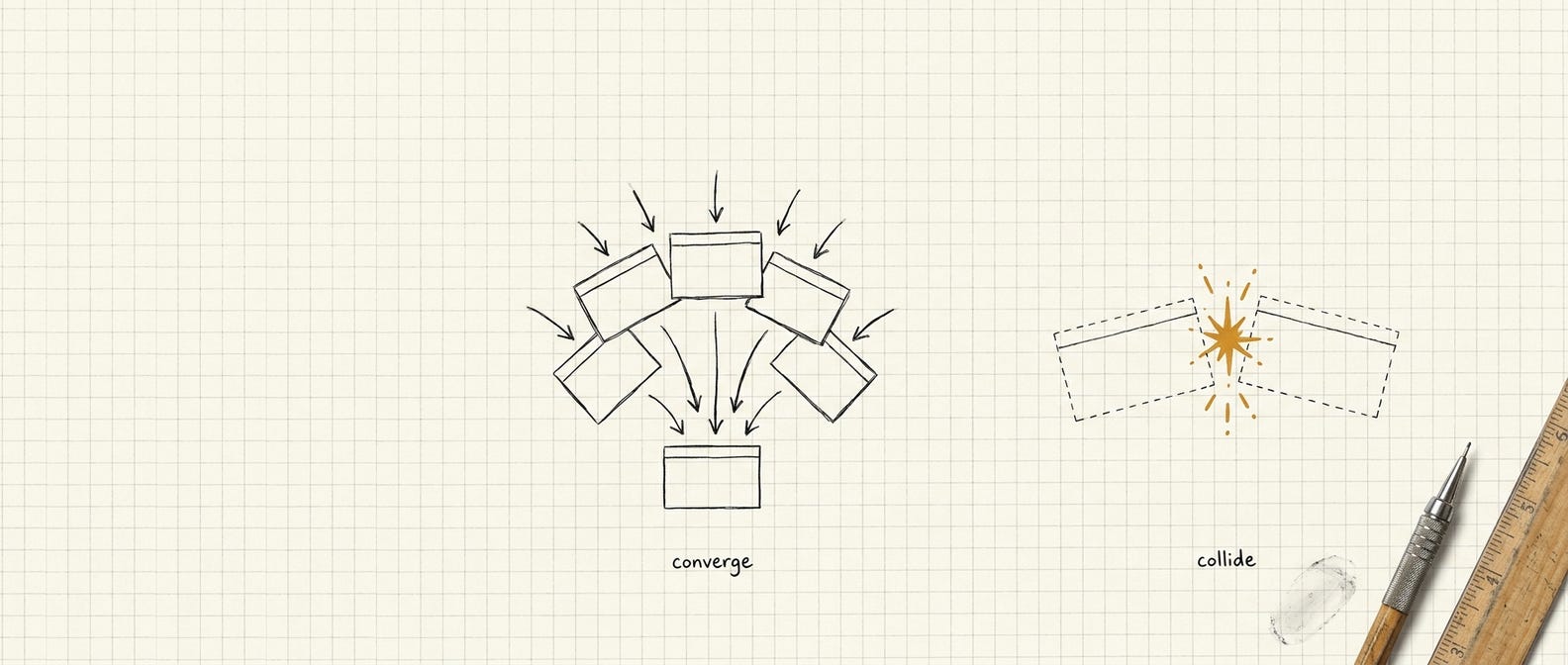
Watch what any of these tools actually does the moment you ask it something. It gathers. It pulls the notes that look relevant, weighs them against each other, and collapses them into a single answer. Many things in, one thing out. Convergence.
That is synthesis — the real thing, done well. When you want an answer, convergence is exactly right. It's how forty scattered notes become the one paragraph you needed. There's nothing wrong with the move. The trouble starts only when you point it somewhere it was never meant to go.
Point it at your own thinking — while the thinking is still forming — and something goes wrong that's hard to see at first.
To a tool built to retrieve, an idea you haven't connected to anything yet is indistinguishable from noise. It has no links, no neighbours, nothing pointing at it. So it doesn't surface. The tool hands you back your tidy, well-connected thoughts — the ones you'd half-finished already — and walks straight past the half-formed one sitting alone in the corner. The orphan. The note that was three weeks from becoming the best thing you'd thought all year, if it had only stayed in view long enough to meet the right second note.
I know how that feels, because I run a clumsy manual defence against it. When a note matters and I can feel it isn't connected to anything yet, I leave it open — a second window off to the side, sometimes a page I print so it physically stays on the desk. Not filed. Just visible. Somewhere my eye keeps catching it.
It works for one note. Two. By the fourth open window the desk is chaos and the trick has eaten itself. What I'm doing by hand, badly, is keeping the orphan alive long enough to find its pair. And it doesn't scale — because the thing I'm reaching for is a move, not a window, and nobody has built the move.
There's a second operation hiding inside the word synthesis, and it's the opposite of the first.
The first collapses many notes into one answer. The second runs backward: it takes two notes that don't obviously belong together and collides them — and instead of an answer, it hands you a question you didn't know you were carrying. Wait. These two are the same thing. Nobody converged that for you. Something just held two unlike things close enough, long enough, that you saw the spark — and the spark was yours to finish.
That's the half that makes new thought, instead of retrieving old thought. And it's the half no memory tool ships. Every one of them is built to reduce noise, and to a noise-reducer the surprising, unconnected, why is this even in here note is the first thing to go. The exact note that was about to matter is the exact note it cleans away.
Here's the part I keep returning to. You already run this second operation. You've felt it — the last time two notes you'd never have filed together suddenly clicked, and a week of fog resolved into one clean line. That was it. That was the move, working.
You just can't run it on purpose. It happens to you, on its own luck — when the right two things are open in the same window, on the same afternoon, in the same tired and receptive head. You can't summon it. You can only leave the windows open and hope.
And that's the strange place I want to leave you.
The most valuable thing your mind does with your own knowledge — strike one new thought off two unlike notes — is the one thing you can recognise instantly, run unmistakably, and not yet begin on purpose. Meanwhile every tool being built this year is busy automating the other half: the collapsing, the retrieving, the half you could already do on your own. The rare half, the one that actually makes something new, is left running on accident. In the corner. Unnamed.
And unnamed is the whole of it. Name the move, and it becomes yours to run on purpose — the turn from it happens to me, on its own luck, to I run it, when I choose. The windows you've been holding open by hand could finally close.
Because it is a move. A specific one, with a shape, repeatable on purpose once you can see it plainly.
The naming is the turn. That's where I'm headed next.
Catch you next time.
— Ambròs
Co-created with AI. The judgment is mine.