
The output was never the point
*If Ai has the output covered, that isn't permission to make more of it. It's a tell.*

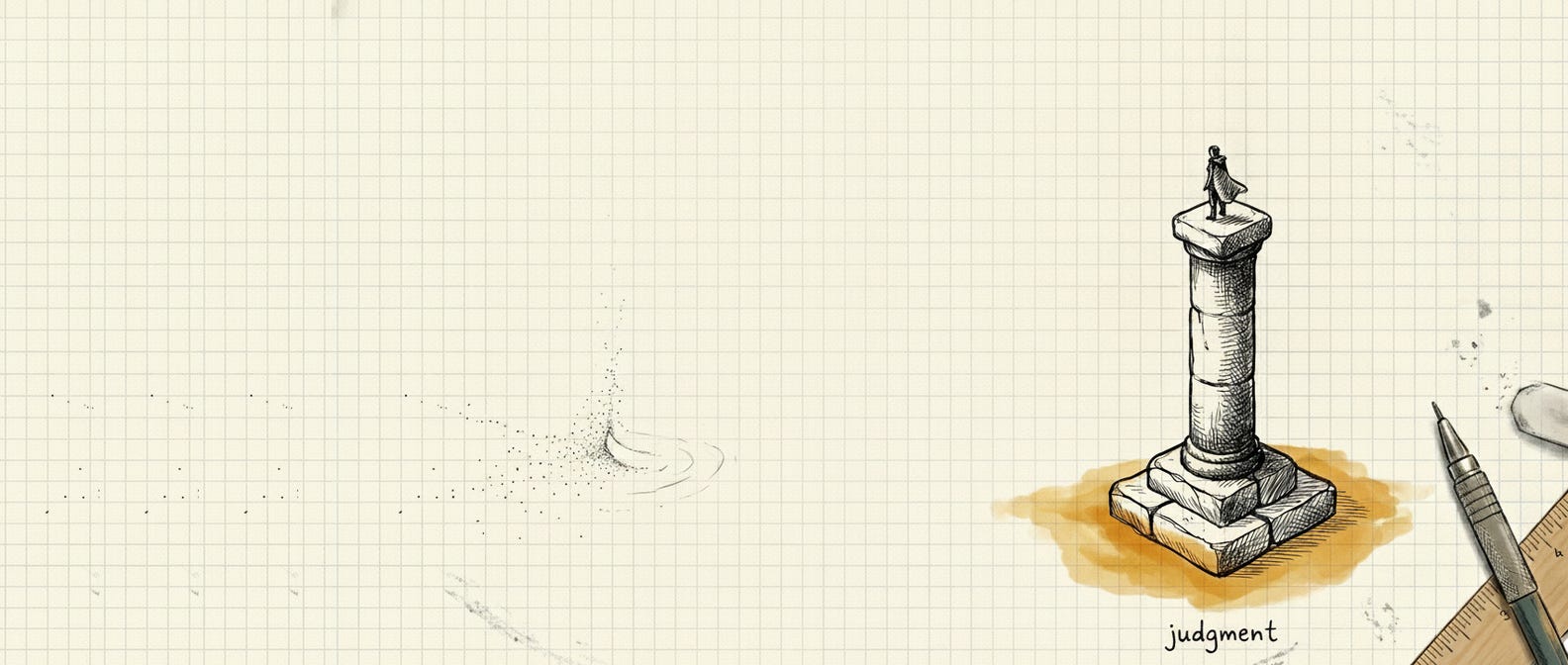
There's a question sitting underneath almost every conversation about Ai right now, and most people are too busy producing to ask it out loud. Is it still worth doing the work myself, now that the machine does it for me? The report, the summary, the first draft, the analysis. It produces all of it, faster, and most days it's good enough. So why am I still here?
The reflexive answer is to lean in. If the machine made output cheap, make more of it. Ship more, cover more ground. Speed is the gift, so use the gift.
I want to slow that answer down, because I think it has the shape exactly wrong.
If Ai has the output covered, that's a signal about where your value was actually living all along — not an invitation to flood the zone. And the signal is uncomfortable: the output was never the point.
Let me be careful here. I am not saying output doesn't matter — someone still has to ship the thing. I'm saying it stopped being the proof. Output used to be how you showed you could think; it was the evidence you'd done the work, the thing that stood in for your judgment. That's the part that's gone.
And it's worth being precise about what made it go. The machine didn't wave a wand. It automated the process — specifically the process that produces competent, middle-of-the-distribution, good-enough output. The average. That's what got cheap. Every disruption before this one automated some particular task; this one automated the producing itself, which is why people keep reaching for this time is different — and for once the worn-out phrase might be earned, though not for the reason they think. The floor — average, competent output — is free now. And when the floor is free, standing on it proves nothing. Output no longer proves agency. The value didn't vanish; it moved — to whatever it was that made the output, and to what the making did to you on the way.
Because every process that produces something does two jobs at once, and only one of them is visible.
The first job is the output. The second is quieter and has no line on the org chart: the process builds something while it runs. A messy afternoon arguing about what a trend means doesn't just produce the trend report — it produces a room of people who now understand the trend, who've tested their read against each other, who'll catch the next one faster. The work was building judgment, relationships, the particular fingerprint that could only have come from you.
The output is visible, and the process is invisible, so when Ai arrives to optimise, it optimises what it can see. It does the first job beautifully and deletes the second — not maliciously, not even noticeably. The deliverable still appears. Only the building is gone.
It shows up at both scales, the same way. In an organisation, the shared understanding never forms — replace each hallway conversation with a clean summary and the company slowly loses the capacity to think together, right when it needs it most. In a single person it shows up as a kind of debt: you produced the thing, but you didn't build the understanding, so next time the understanding isn't there to draw on. The output was perfect. Nothing underneath it was theirs.
I've come to picture it as an iceberg. The output is the tip above the waterline — pointable, measurable. The process is the mass underneath — the understanding, the relationship, the judgment that never showed up in any deliverable. Ai shaves the tip and calls it efficiency. You get faster output and slower thinking, and nobody can quite say what was lost, because the thing that was lost was never on a dashboard.
I wrote a version of that line — the output was never the point, the process was — back in March, looking at organisations: the hallway conversations, the "what are you seeing?" between two peers, the informal mess that's how groups navigate things no procedure covers.
Then a few months later I watched Jess Wiseman, an artist and designer, reach the same sentence from the opposite end of the scale. No theory of organisations, no interest in coordination — her ground was personal: the learning that happens while you make the thing, the fingerprint your own struggle leaves in it. The output was never the point, she said in her TEDx talk — AI has output covered. Same words. Cold. Months apart. Neither of us had heard the other.
I'll be honest about my first reaction, since it's the unflattering kind. Some quiet part of me had been holding that line like it belonged to me — and there it was, arriving fully formed out of a young artist who'd never read a word I'd written. The ego sting lasted about a second. Then it turned into the most reassuring thing that's happened to this idea, because one person saying a thing is a position; two people reaching the identical sentence from the individual end and the organisational end, with no contact, is closer to the shape of the thing itself. One shift wearing two faces — what happens to a person making something, and what happens to a company coordinating — rhyming because it's the same loss underneath.
So the move is not to celebrate the faster output. Producing output, it turns out, was only the first rung of the agency ladder — the lowest one, the one the model now stands on for you. Climbing back onto it and stamping harder — more output, faster — just crowds you onto the one step everyone can already reach.
Agency is the rest of the ladder: what you build above that first rung, and where you anchor it. There are two ways to climb, and they sit on very different ground. One is to get good at steering the machine — stacking up the context, the prompts, the right harness around the right model. That capacity is real and worth having. But it's anchored in sand: every new model rearranges the floor under it, and the trick you mastered last year is half-obsolete by spring. The other is to keep building your own agency — your judgment, your understanding, work that is recognisably yours, done with the full power of the machine rather than in place of it. That ground is solid. The models will keep changing; the agency compounds.
Output stopped proving you have that agency. From here you have to show the thing underneath it — the thinking, the process you can still run when the tool is switched off. Which means the real task was never producing more. It's keeping the second job — the capacity and the fingerprint the process was quietly building — and catching the moment an optimisation is about to carry it off.
You can already feel which of your own processes have handed that second job away — and you can probably name the one optimisation, this week, that's about to take another. What you can't quite do yet is rebuild the process so it still does both: ships the output and keeps building you, on purpose, by design, instead of by the luck of which corners you haven't automated yet.
That rebuild is a move with a shape — a name, a few rules, learnable. Turning protect the process from a wince into something you can actually run is the part I want to put in your hands next.
Catch you next time.
— Ambros
Co-created with AI. The judgment is mine.